
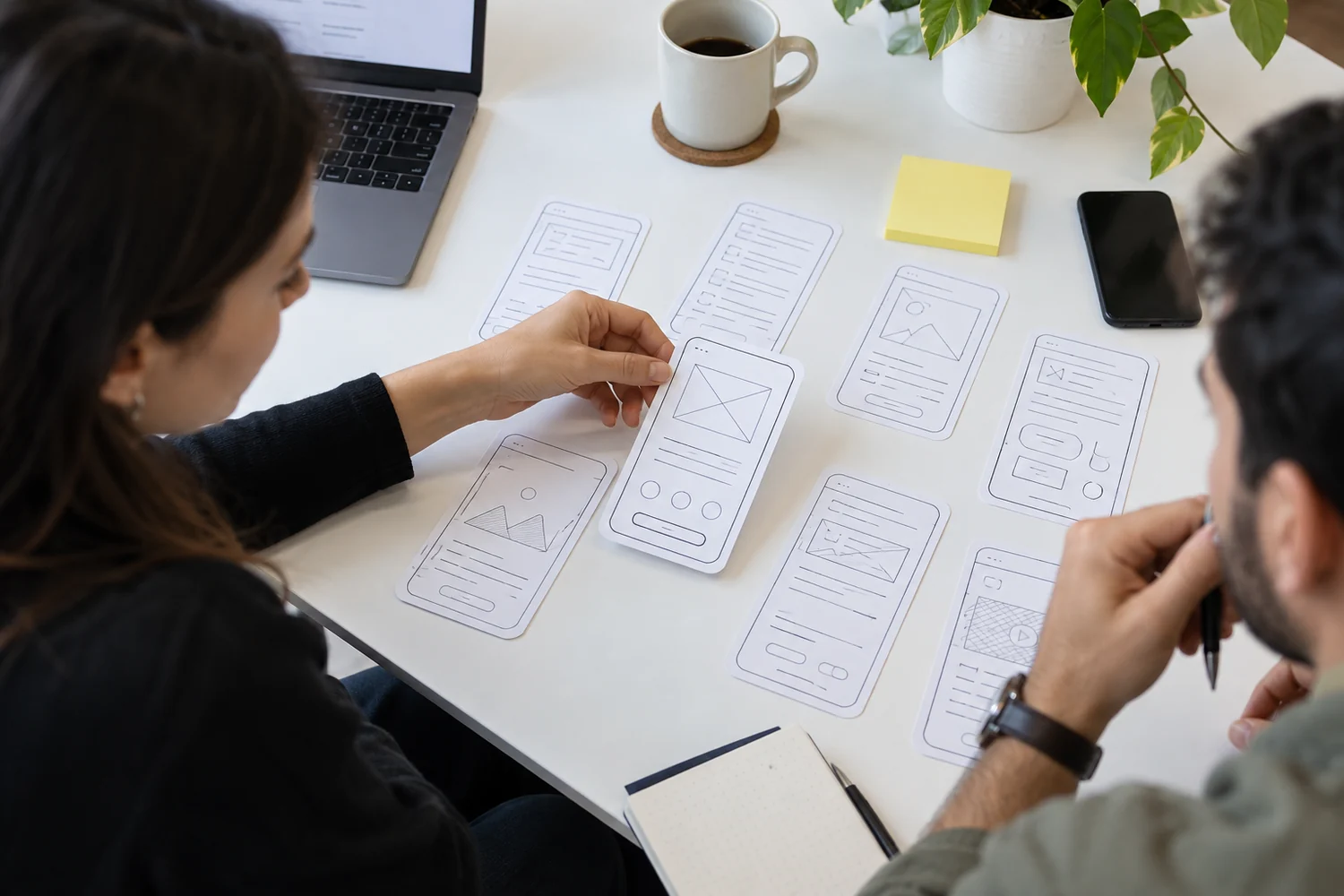
A prototype is not an early version of the app. It is a way of finding out whether anyone wants it, for a fraction of the cost of finding out the expensive way.
The most expensive way to discover that an idea does not work is to build it. A prototype exists to move that discovery forward, into a week of work rather than four months of it.
The confusion is that the word covers several very different things, from a sketch on paper to something that looks and behaves exactly like a finished app. Choosing the wrong level wastes either time or the answer you were looking for.
This article covers what a prototype is genuinely for, which level to use when, and how to avoid the common outcome where a prototype is built, admired and answers nothing.
The essential point is that a prototype tests a question, and deciding the question before building is the entire discipline.
The last one is worth naming separately. A great many prototypes exist not to test users at all but to get five people in a company to look at the same thing and discover they had been describing different products in the same words.
A prototype that everyone admires and nobody learned anything from was decoration. The purpose is to be told you were wrong while it is still cheap.
A prototype also has a scope, and keeping it narrow is what makes the exercise quick. Build the one path that carries the risk — the sign-up, the booking, the checkout — and nothing else. Screens that exist only to make the prototype feel complete take time to produce, add nothing to the answer, and encourage participants to wander away from the task you were actually testing.
| Level | Time | Answers | Does not answer |
|---|---|---|---|
| Paper sketches | Hours | Structure, order of steps | Anything about feel |
| Clickable wireframes | Days | Flow, comprehension | Visual appeal, performance |
| Designed prototype | 1–2 weeks | All of the above plus impression | Whether it can be built as shown |
| Working demo | Weeks | Technical feasibility | Not really a prototype any more |
Most projects should start one level lower than they expect to. Paper and wireframes produce the most learning per hour spent, because they are quick enough to change after every conversation and nobody is emotionally attached to them.
The designed prototype becomes worth it when the question involves impression rather than comprehension — whether people trust it, whether it feels like something they would pay for — or when it is being used to align a team or to show investors.
Realistic content matters more than most people expect. A prototype filled with placeholder text and neat sample data tests a world that does not exist: real names are longer, real product titles wrap onto three lines, real lists are either empty or contain four hundred items. Using genuine content, including the awkward cases, regularly reveals layout problems that would otherwise have been discovered after the app was built.
A prototype that looks finished changes the feedback you get, and usually for the worse.
People shown a polished screen comment on colours and wording. People shown a rough wireframe comment on whether the thing makes sense, which is what you needed. The less finished it looks, the more willing people are to say it is wrong.
The same applies internally. A designed prototype is difficult to abandon because visible effort went into it, and teams routinely proceed with a flow they had doubts about because redoing it would mean throwing away two weeks of work.
Five participants is enough to find the major problems. The same obstacles start repeating by the third, and the tenth participant rarely tells you anything new.
Give them a real task to attempt, not a guided tour. "Order a delivery for tomorrow evening" produces useful behaviour; "have a look and tell me what you think" produces politeness.
Then stay quiet. The strongest instinct in the room is to explain, and every explanation destroys the finding — if the participant needed you to explain it, real users will have nobody to ask.
Watch what they do rather than listening to what they say. People are consistently wrong about what they would do, and reliably informative about what they just did.
Test on the device people will actually use. A prototype reviewed on a large monitor hides everything that matters on a phone held in one hand: the reach of a thumb, the text that becomes unreadable, the button that sits under the keyboard. Putting the prototype on a real handset takes minutes and changes what the session finds.
Testing with colleagues tells you very little, because they know what the product is for and cannot un-know it.
The participants should resemble the people who will actually use it: the same familiarity with technology, the same reason to be there, the same amount of patience. Testing a delivery app for restaurant staff with a group of software developers produces confident results that do not survive contact with a busy kitchen.
If genuine users are hard to reach, people outside your industry are still better than people inside your company.
Several questions are outside its reach, and treating a prototype as evidence for them is where projects go wrong later.
It cannot tell you whether the app will be fast, whether the integration will work, or whether the design is buildable within budget. A prototype has no data, no backend and no constraints, and a flow that feels effortless when every screen appears instantly may feel very different when a step takes three seconds.
It also cannot tell you that people will pay. Willingness to click through a prototype is not willingness to open a wallet, and the distance between the two has ended more products than any usability problem.
Who runs the session affects what comes out of it. Someone closely involved in the design finds it almost impossible not to defend the work, and participants read that quickly and soften what they say. Where possible, have the session run by someone with no stake in the outcome, and let the designers watch rather than speak — it is uncomfortable, and it consistently produces the more honest hour.
The prototype's second job begins after the testing, because it is the clearest specification a development team can be given.
A screen that has been tested and revised answers questions that a written requirement leaves open: what happens when the list is empty, what the error says, where the back button goes. Each of those is a decision that otherwise gets made by a developer at speed, or asked about in a meeting a week later.
Record what was learned alongside it — what was changed, and why. Six months on, someone will propose the thing you already tested and rejected, and the note is what prevents that conversation happening twice.
Expect to revise between sessions rather than only at the end. If the first two participants both stumble on the same screen, changing it before the third is more useful than collecting three more examples of a problem you have already understood. Prototypes are cheap to alter, and that is precisely the property you are paying for.
A prototype is not always the right investment. If the product is a well-understood pattern — a straightforward catalogue, a standard booking flow — the flow is already settled, and time spent prototyping it is time not spent building.
It is also unnecessary when the real risk is technical rather than human. If the open question is whether the integration is possible, a prototype of the screens answers nothing and a technical spike answers everything.
The staged reasoning here is the same one we set out in our article on building a mobile application.
Finally, agree in advance what would make you stop. A prototype is only a genuine test if some result would change the plan, and a team that intends to build the app whatever happens is running a demonstration rather than an experiment. Writing down the outcome that would cause a rethink, before the sessions begin, is what keeps the exercise honest.
Decide the question before you build anything, use the lowest fidelity that can answer it, test with five people who resemble real users, give them a task and then stay quiet, and keep the prototype afterwards as the specification. What it cannot tell you is whether the thing is fast, buildable or worth paying for.
You can see our approach to cross-platform app development, custom web applications and the wider web and mobile solutions area on the service pages. If you would like your own idea shaped into a testable prototype, request a free consultation.

Subscribe to our newsletter to stay up to date with the latest news and updates!
Bakı, Azərbaycan
© 2026 MyCode. All rights reserved.


